 Catacombs Credits Guide
Peter Medak
Catacombs Credits Guide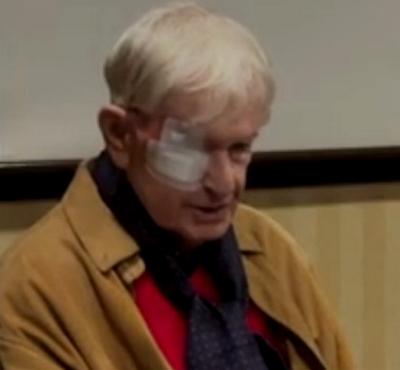
Comments at the Los Angeles 2025 convention
It's kind of strange to be here and to see some of the wonderful actors who were there at the time. Most of it I don't remember, unfortunately, because 50 years is a long time.
I did many things after that, I worked on 28 films and I want to say hundreds of television episodes of all kinds. Everybody was saying to me after Ruling Class (1972) which I did with Peter O'Toole, which was my third feature film, they said you're crazy why are you doing television?' And I said, "Because between movies, I love to do that, because you meet new actors you would have never met." And then later on in my career, I used quite a lot of them. And so that's why it was important to do it.
Suddenly my career took off after my very first film, which was Negatives (1968) and with this unknown actress Glenda Jackson in it. She become a big star. Glenda and I stayed in touch through both of our lives until she passed away. And she was an incredible, incredible lady and an incredible actress.
Going back to Space 1999, I loved it because it it's something which I wasn't familiar with. It was great to get to know all the whole space stuff, you know, and the models, you know, and and all the actors who were wonderful. I just saw Nick Tate, who of course I haven't seen since then. I bumped into quite a lot to Martin Landau and and Barbara Bain over the years. Time just flies, and it's a long time ago and it's strange for me to be here today because it brings back so many memories, not really about the story but about the people and about the actors and the actresses, you know.
I'm now 88 years old. I'm still not giving up and I'm going to do it yet again. When I worked with Gary Oldman when I did Romeo's Bleeding (1993). We knew each other before, but that's why the film had happened, because we wanted to work together. I love actors and actresses very much, and they know it immediately, and they trust you with everything they got. It's like handed to me in a golden plate.
When I work with George C Scott on The Changeling (1980), everybody told me that George is very difficult as an actor and it's not going to be easy to direct him or you. It took me about two days when we started shooting to absolutely conquer him. From that point on, I could do anything with him. He trusted me. He used to call me 'my crazy Hungarian' When he came on the movie set, wherever we were shooting, and he couldn't find me, he said, "Where is my crazy fucking Hungarian?" I just love George. I'm very proud of it because it I always loved the supernatural and I particularly loved the changeling, because it was a real supposedly true story, but I just made it my own. I had a great time doing that film and it was a piece of cake for me to do it
There may have been one or two [films] which I was disappointed myself with. It all was because I wasn't allowed to do what I wanted to do, and there was tremendous interference from the studio or from those producers. But it's not a bad average, two out of 20 movies and they were a joy and a pleasure for me to make them. I dream about them and I often dream about Peter O'Toole, who's passed away quite a few years ago, and I'm directing him and working with him. And when I wake up from the dream, it was a pleasure, because we spent more time together again.
I had an amazing aunt who was a very famous soprano, not in Hungary, I was living in Hungary at the time, but in the west, in Prague, in Vienna, in London, in America, at the Met and all that. She gave me for my birthday, I keep thinking it was for my seventh or eighth birthday, a 35 mm film projector and a piece of film. I used to close all the windows and projected film. I can't believe [my memory] because I know what a 35 mm projector is and it's not what you give as an easy birthday present. That's how I remember it and from that point on I wanted to direct
I did everything, wherever life threw me, through the Hungarian revolution in 1956 to London. When I got to London, I immediately entered the film business again through my aunt's help, who was living in London then. I went through every department in a matter of three years. I never went to film school, I learned just that if you didn't do good in this job, you would go into the next one, and the next one, and the next one.
One time I was fortunate enough when I was an assistant director, years before in England, to work with David Lean. He hardly ever said anything to the actors except over smoking a cigarette. I learned from David's silence, getting his way. When you've seen any of his movies, they were just magic, and you kind of you connect to into each other's soul and it's magic.