 Catacombs Credits Guide
Barbara Bain
Catacombs Credits Guide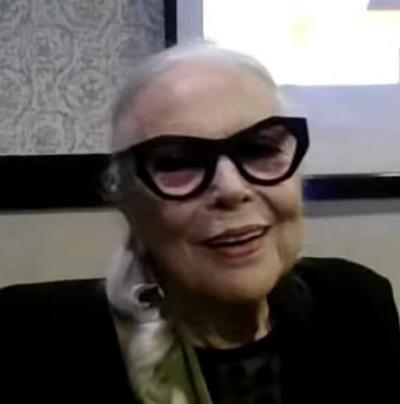
Comments at the Los Angeles 2025 convention
The one time I had a kind of funny moment and the whole episode was a little funny for many reasons [The Full Circle]. What I'm talking about is the one where I played an ape. I had to make some kind of guttural sound, but I wasn't sure what that was. So, I kind of went up in the dressing room before the shot and made a crazy sound. I had no idea how to make a really guttural animalistic sound. One doesn't do that a lot. Maybe you do. I don't know. But anyway, that's the funny part of that episode from was my teenage daughter. I went home in the makeup, the hair, the stuff because I was kind of late and I wanted to get home for dinner. she had her first date coming over for dinner, which I didn't know. "This is mom." That wasn't nice to do to a kid.
Sylvia and Gerry {Anderson, producers]. They came to visit us in California and we talked about it. Clearly she [Helena] was educated well character had a big job running a medical situation and so I decided, I didn't even mention this with with them, but I decided for myself that her father, my father, had cured cancer. So now I have a big obligation to do something quite wonderful in the world and was measuring myself against that parent. My father did not care by the way at all. But you know what I'm saying? So some of those choices were just related to what was presented and then I take them and go with them. I can kind of go from that feeling.
The costumes were were done by Rudi Gernreich as you know and that was a question of Sylvia's mentioning in our home that day. that the only American designer she was interested in if possible was she knew, he was retired by then, was Rudi Gernreich. I said "well he's been a friend of mine forever".
Rudi and I met in New York when he first showed his first collection to the woman who was a terrifying woman who ran Harper's Bazaar at the moment, Diana Vreeland. I was there as a model, being seen, and he was there to show his clothes, and we were both skinny, and we were both scared, and we were both very young. He was so excited to tell me, "What do you think? Do you think they're good? You think they're okay?" And he opened up the stuff he had on a rack. They were gorgeous, and they were based on dance and I was a dancer. So, I kept going, "Oh, I love the work." That cheered him up. He told me he thought I was pretty good-looking, and I was going to do all right. So, we were like these two little kids in the outer office of this very powerful woman, totally panicked. That moment is how long I knew Rudi. He became very successful. I did what I did, but we kept touch all through the years. He visited us in London.
So I said, "Oh, I call Rudi. Maybe he'll do it." And he had retired. And the interesting thing about Rudy Gernreich, he was a he was a philosopher at heart. And I said to him, "What do you think we'd be wearing in 1999?" And he said, "Armour". He said, "I can't do that because you can't act in it." So that's how that was put how the uniforms were designed by Rudi made. It was very complicated, but they worked it all out. So those that's those elements that happened prior to shooting.
We did have some early discussions with the writers who were very good but also very trained traditionally in a dramatic form and television is not a traditional dramatic form because it has four breaks. It doesn't just tell a story, get to a big moment, and then end. That's what normal classical form is. You got commercials, honey. You got commercials all along the way. And you got to have what they call a cliffhanger. So, something very exciting has to happen, otherwise they're going to leave the room. So, you got you got to keep breaking up the script until you climb up. Well, that's not an easy idea to translate when you're not if you don't write that way, right? So, we had to kind of bring them into that idea as Americans.
Now, Lord Lew, he became Sir Lew became Lord Lew. He wasn't even Sir, he was just Lew when we first met. [Lew Grade was already Sir Lew Grade, since 1969. He became Lord Lew Grade in 1976 during Year 2 production] He didn't care about the American market really. He wanted the universal market. He was the first person who thought of the universal market. So we weren't geared to hit the American deadlines for production.
They built that set [Main Mission] which was as big as this room. Well, a standing set in a television series is usually as big as this part of this room. So, you can get in and get out in half a day. That's traditional here [in Hollywood]. Sometimes now you see a bigger set. That set, well, it took two days to shoot it instead of half a day. But again, he [Lew Grade] didn't care. So we had the luxury of that extraordinary set.
[Of guest stars] Absolute heaven, being in England and working with Maggie Leighton, Christopher Lee. Christopher Lee is the tallest man it was at the time in London. And they put him on an apple box. He'd never been on, you know, an apple is a thing on the set where you make a person taller. Christopher Lee, we have a scene together. He had to be twice as tall as he was. They put him on an apple box and I had to talk to him like this and he he he was tickled by the whole thing. He thought it was very funny, very sweet guy. And there we were. Chris a really special guy. Like I said, Maggie Leighton. There were so many people from the theatre.
Roy Dotrice was a darling man. I adored him. Just adored him. He was just lovely. And I saw a play he did, he came to Broadway and did a one-man show on King Charles II, I believe [Brief Lives by Patrick Garland, about John Aubrey's biographical sketches, written in the time of King Charles II but the king is not personally profiled]. And it was very funny and very good.
Bille [Whitelaw] and I were going to do something together in the theatre. Bille died. Bille did [Samuel] Becket. She was beautiful, beautiful actress and lovely person. They were very special. They were well trained all of them and loved working and I can't think of any one of them wasn't fun to be around.
Barry Morse. Oh god, what a sweetheart. He brought us in so we would understand where we were. He brought us in a headline from the press, the British press. It said "storm in the channel, continent isolated." Not Britain. The continent was isolated, so we knew where we were. It was right away. He would just say, this is who this bunch of people were. [The headline is sometimes "Fog in Channel, continent cut off", usually attributed to the Times. It has been widely quoted since the 1930s, but all uses since then have been satirical; it was never an original headline] Barry was wonderful. Lovely, lovely, lovely man.
That title card with September 13th was kind of an in-house joke. It was my birthday, but nobody knew that out front, and we weren't advertising it. It was just there.
Charlie Crichton, who is a wonderful, wonderful director and funny guy who pretended he was a curmudgeon, but he really was a sweetheart. And we had that episode. You all know the name, with the foam [Space Brain]. Well, Charlie, he's in the middle. We're where we are. The foam is rising up and he starts yelling, "Stop the foam." But they didn't. Charlie's covered up. We're all covered up, and nobody ever stopped the fall. It was hysterical. And of course, because of the size of that set, they had to clean it all up and start all over again. It took another week, or so. But Charlie's voice, way over there going, "Stop the foam".